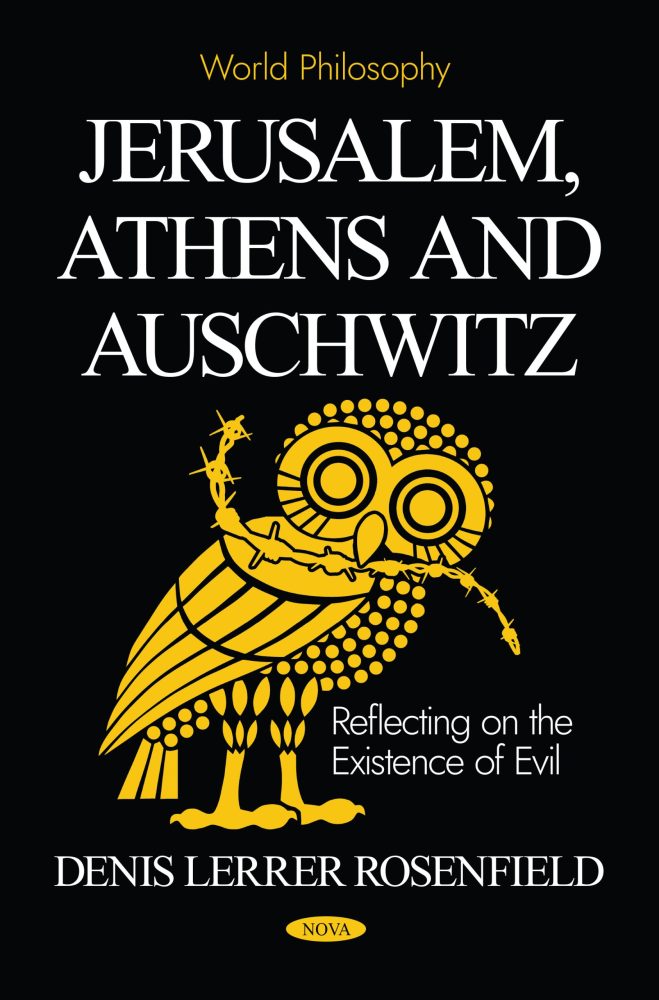
This book is about fear and its liberation. Its scope is quite broad, exploring philosophy, theology, history and politics, with the idea of evil serving as both a backdrop and guiding thread, whose historical reference is Auschwitz as a symbol of a new form of death and evil. Not only death in the natural sense, but death in its political and, more particularly, totalitarian meaning. Philosophically, there are abundant references to Hobbes and Hegel, with particular emphasis on the latter’s lord-bondsman dialectic as presented in the Phenomenology of Spirit. In a theological sense, there is an extensive discussion with Jewish, Catholic, Protestant, and Evangelical thinkers framed by the concept of evil as it arises and develops during and after the War. Among Jewish thinkers, emphasis is given to Kabbalah, Maimonides, Moses Mendelssohn, Moses Hess, Abraham Isaac Kook, Martin Buber, Franz Rosenzweig, Emil Fackenheim, Abraham J. Heschel, Elie Wiesel, Primo Levi, Hans Jonas, Gerschom Scholem, Vladimir Jankélévitch, Emmanuel Levinas, Arthur Cohen, and Richard Rubenstein; among Catholics, Etienne Gilson, Gaston Fessard, Henri de Lubac, François Mauriac, Hans Urs von Balthasar, Gabriel Marcel, Pope Pius XI; among Protestants and Evangelicals, Karl Barth, Paul Ricœur, Mark Lindsay, George Hunsinger, Alice and Roy Eckart, and Franklin Littell. Politically, the discussion includes both a reflection on the Nazi experience in Germany and France, as well as an analysis of a theorist of Nazism such as Carl Schmitt and an “operator” such as Himmler. Historically, the reference points are Germany, with an emphasis on the rise of Nazism and its totalitarian practices, and France during the occupation, with a focus on the “spiritual resistance” embodied by the Jesuits gathered in Lyon, as well as the role of the Jewish Councils, particularly the great moral figure of Adam Czerniaków, the “mayor” of the Warsaw Ghetto.
| Publisher | Nova Science Publishers |
| Country | USA |
| Publication Date | 02/09/2025 |
| Pages | 311 |
| Edition | First edition |
| About the Author | Denis Lerrer Rosenfield – Retired Professor in Philosophy at the Federal University of Rio Grande do Sul, Porto Alegre, Rio Grande do Sul, Brazil |
| Publisher Address | support@novapublishers.com |
| ISBN | 979-8-89530-791-5 |