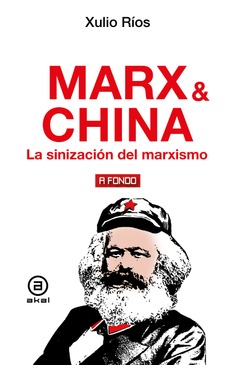
This book examines one of the most controversial aspects of contemporary China, an aspect often treated superficially or openly or deliberately ignored. Yet, those working within this Asian giant see it as a central axis around which its remarkable transformation has revolved: Marxism. What role has it played? Isn’t this country a prime example of state capitalism? Or would it be more accurate to describe it as market socialism? How can this duality be reconciled, if indeed this contradiction is even sustainable?
From the era of Mao and the beginnings of the Chinese Revolution, through Deng Xiaoping and his reforms and opening up, to the presidency of Xi Jinping, the Chinese Communist Party insists that Marxist ideology constitutes one of its theoretical pillars and a guide to political practice. But it adds that it is not merely a copy-paste of other experiences; rather, it has adapted it to its own reality and era, integrated it with the cultural traditions of its civilization, and uses it only when it guarantees its leadership and the achievement of its goals. Let us then examine what Marxism with Chinese characteristics entails—a map that has turned the international balance of power upside down and challenged our belief in an indispensable model of development and governance.
| Publisher | Ediciones Akal |
| Author | Julio Ríos |
| Country | Spain |
| Publication Date | 20/03/2025 |
| Pages | 273 |
| Edition | first |
| Size | 14.53 x 2.34 x 21.67 cm |
| About the Author | Julio Ríos is the founder and honorary advisor of the China Policy Observatory and a consultant at Casa Asia. He contributes to numerous media outlets and specialized journals and serves on the scientific boards and editorial boards of several Chinese publications. ... Read more about Julio Ríos |
| Publisher Address | atencion.cliente@akal.com |
| ISBN | 978-84-460-5701-7 |