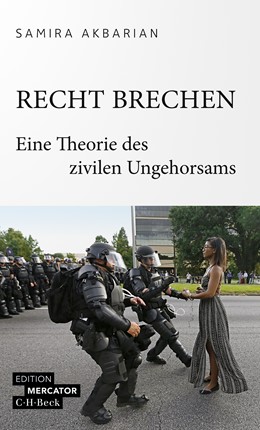
Is it disproportionate? Unconstitutional? Moral? Criminal? Current manifestations of civil disobedience are highly controversial. But what truly defines civil disobedience? Do climate activists, protesting farmers, and citizens of the German Reich justify their actions with this term? We desperately need a compelling and universally understandable theory of civil disobedience, and the distinguished legal scholar Samira Akbarian has provided one.
The importance of civil disobedience to our democracy lies precisely in its risks: by exposing the shortcomings of democratic processes, questioning the conditions of participation, and reflecting reality before us. Thus, breaking the law, as Samira Akbarian explains, can serve the realization of democratic ideals. Therefore, we must question the notion that civil disobedience harms democracy and the rule of law. It is not about justifying all forms of civil disobedience, but about learning to distinguish between its democratic and authoritarian expressions. Akbarian’s thesis is that successful forms of civil disobedience should be understood as “interpreting the constitution.” In her book, she elaborates on this intriguing thesis and demonstrates how civil disobedience can exert direct democratic influence, potentially addressing dysfunctions in political processes.