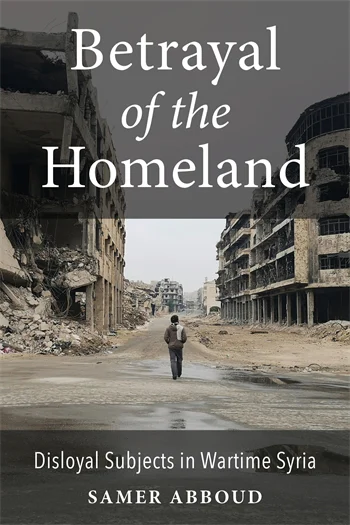
The Syrian regime withstood the uprisings that began in 2011, supported by a Russian military intervention in 2015 that changed the course of the conflict and led to the government taking more territory, until its final collapse in 2024. During this period, how did the state attempt to manage the conflict away from the battlefield and re-establish its control over the population?Samer Abboud believes that the Syrian regime sought to consolidate its rule during the war by dividing society into “loyal” and “disloyal” subjects, and punishing those it considered traitors. The regime portrayed the conflict as a war on terrorism, portraying its opponents as traitors to the homeland.In the period since 2015, the government has enacted new laws, established courts, and defined legal categories targeting “treason,” which may include anything from evading military service to absenteeism, to publishing critical posts on social media. Disloyal individuals were subjected to various forms of punishment and were banned from re-entering the country if they had been displaced.Abboud combines regime narratives and discourses with the mechanisms of bureaucratic practices, tracing how the state carved the gap between loyalty and betrayal. Rich with empirical information and well-grounded in theory, Homeland Betrayal provides a comprehensive view of the politics of punishment during the last decade of Assad's rule, with broader implications for understanding how authoritarian states manage conflicts.
Betrayal of the Homeland Disloyal Subjects in Wartime Syria
خيانة الوطن: رعايا غير موالين في سوريا زمن الحرب
Not Translated
Listen to book
Bibliographic Data
| Author | |
|---|---|
| Publisher | Columbia-Global-ReportsWebsite |
| Country | أمريكا |
| Primary Category | Ideas and Policies |
| Published | 2026 |
| Language | English (EN) |
| Pages | 264 pages |
| Edition | الأولى |
| ISBN | 9780231215336 |
| Translation | Not Translated |
About Samer Abboud
Samer Abboud is Associate Professor of Interdisciplinary Global Studies and Director of the Center for Arab and Islamic Studies at Villanova University. He is the author of the book Syria (2nd edition, 2018).