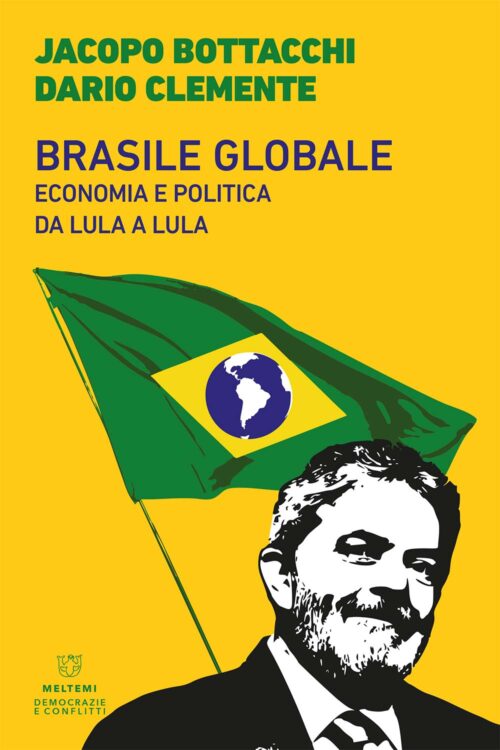
This article examines Brazil's economic and political transformations in the 21st century, focusing on the period from 2002 to 2022: from the initial phase of growth and development, through the economic, social and political crisis that led to the rise of Bolsonaro, to Lula's return to the presidency.The authors explore the context of Latin America and Brazil's emergence as a regional and global power, analyzing relations with China, the United States and the European Union, the expansion of the BRICS group, and Brazil's entry into OPEC.
Brazil's global economy and politics from year to year
الاقتصاد والسياسة البرازيلية العالمية من عام إلى آخر
Not Translated
Listen to book
Bibliographic Data
| Author | |
|---|---|
| Publisher | MeltemiWebsite |
| Country | ايطاليا |
| Primary Category | Ideas and Policies |
| Published | 2025 |
| Language | Italian (IT) |
| Pages | 214 pages |
| Edition | First |
| Dimensions | 14×21 |
| ISBN | 9791256152667 |
| Translation | Not Translated |
About Jacopo Bottacchi
Jacopo Botacci holds a PhD in political and social science from the University of Bologna, and was a researcher in Latin American history at the University of Turin. His research focuses on the political and institutional history of Brazil between the 20th and 21st centuries, and on inequalities in Latin America, with a particular focus on their roots and public policies aimed at reducing them.
About Dario Clemente
Dario Clemente lives in Argentina, where he is a researcher at the National Council for Scientific and Technical Research (CONICET) and a professor at the National University of San Martin and the University of Buenos Aires. His research focuses on South American integration into the global economy, from the perspective of international political economy, combining a critical re-examination of dependency theory with the highlighting of Latin America's rich Gramscian heritage.