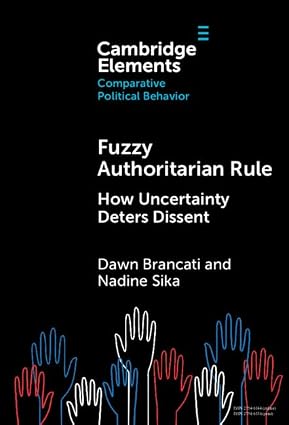
Many authoritarian regimes, including some of the world's most populous autocracies, such as China and Egypt, often do not make it clear what views, attitudes, and behaviors people may express openly without being sanctioned. This Element investigates how the uncertainty that this style of rule instills among people impacts the effectiveness of repression in deterring dissent. The authors develop a novel argument about how it can magnify the effect of repression by affecting how people understand what repression signals about a regime's resolve to sanction dissent. Their analysis, based on two laboratory experiments conducted in Egypt, confirms their argument and, in the process, challenges aspects of prominent behavioral arguments linking negative emotions to uncertainty. The authors' results imply that repression is least effective against acts of dissent regimes are opposed to the most and are very clear about their resolve to repress them as a result.
Fuzzy Authoritarian Rule: How Uncertainty Deters Dissent (Elements in Comparative Political Behavior)
الحكم الاستبدادي الغامض: كيف يردع عدم اليقين المعارضة (عناصر في السلوك السياسي المقارن)
Not Translated
Listen to book
Bibliographic Data
| Author | |
|---|---|
| Publisher | Cambridge University PressWebsite |
| Publisher Address | Cambridge University Press |
| Country | Britain |
| Primary Category | Ideas and Policies |
| Published | 2026 |
| Language | English (EN) |
| Pages | 75 pages |
| Edition | The first |
| ISBN | 978-1009731737 |
| Translation | Not Translated |
About Dawn Brancati
**Dawn Brancati** Affiliation: Brown University and Yale University