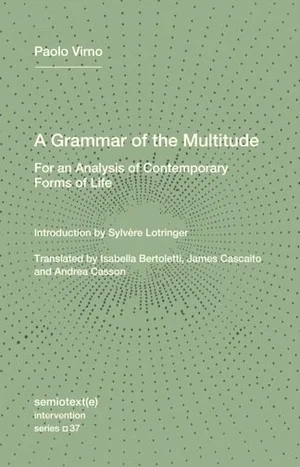
Paolo Verno's Grammar of the Masses became the most famous work of the Italian theorist in English, influencing a generation of activists and performers, when it was first published by Semio Text in 2004. Two decades later, this new edition proves that Verno's depiction of contemporary life - as a map of virtual reality made possible by post-Fordism - was strikingly forward-looking.At the beginning of the 21st century, globalization forced a rethinking of some categories - such as “the people” - that had traditionally been associated with the now eroding state.
Verno argues that the concept of “the masses,” developed by Spinoza and largely neglected since the 17th century, is a far better tool for analysing contemporary issues than Hobbes's concept of “the people,” favoured by classical political philosophy. Hobbes, who hated the idea of the masses, defined this idea as a rejection of political unity, resistance toauthority, and not to enter into permanent agreements.
“When they revolt against the state,” Hobbes wrote, “the citizens are the crowd against the people.” But crowding is not just a negative concept; it is a rich concept that allows us to re-examine multiple experiences and unrepresentative forms of democracy.