Why do so few working-class people reach elected office? In a normal democracy, working-class jobs make up about 70 percent of occupations, but only 2 percent of national legislators come from working-class jobs.In their book "Workers' Exclusion from the Ballot," Nicholas Carnes and Noam Lobo show that this disparity is not because working-class people are less attractive to voters, less interested in running, or less competent. The problem is not limited to specific countries, campaign finance systems, or specific electoral systems. Rather, Carnes and Lupo believe that it is the nature of elections themselves that excludes workers from the ballot box and from public office.Carnes and Lobo point to two inherent features of elections that discourage working-class candidates across democracies around the world. Running for public office naturally entails significant personal burdens—giving up time, energy, and certainty about the future—that are difficult for people in low-wage, labor-intensive, and precarious jobs, such as manual laborers, retailers, and home health aides.In turn, party managers have strategic motives to favor potential candidates who can more easily meet nomination requirements and, as a result, ignore qualified working-class members. Carnes and Lupo assert that workers will not have an effective role in our political system unless parties establish institutional partnerships with strong labor organizations, or unless democracies adopt alternative forms of leadership selection that tap directly into the views of ordinary citizens.
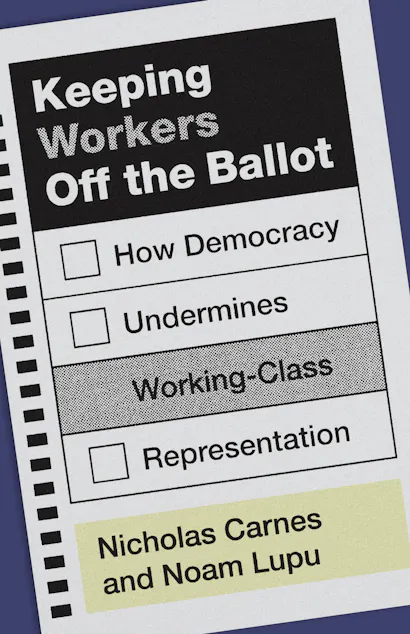
Keeping Workers Off the Ballot: How Democracy Undermines Working-Class Representation
إقصاء العمال عن الاقتراع: كيف تقوض الديمقراطية تمثيل الطبقة العاملة
Not Translated
Listen to book
Bibliographic Data
| Author | |
|---|---|
| Publisher | Princeton-University-PressWebsite |
| Publisher Address | info@press.princeton.edu |
| Country | USA |
| Primary Category | Ideas and Policies |
| Published | 2026 |
| Language | English (EN) |
| Pages | 232 pages |
| Edition | الأولى |
| Dimensions | 5×8 |
| ISBN | 9780691285290 |
| Translation | Not Translated |
About Nicholas Carnes
Nicholas Carnes is the Zed Chair Professor. Smith Reynolds Professor of Public Policy and Professor of Political Science and Sociology at Duke University. He is the author of White Collar Government and The Money Ceiling (Princeton).
About Noam Lupu
Noam Lobo is the Gertrude Conway Vanderbilt Professor of Political Science and director of the Center for Global Democracy at Vanderbilt University. He is the author of Signs of Parties in Crisis and co-editor of Unequal Democracies.