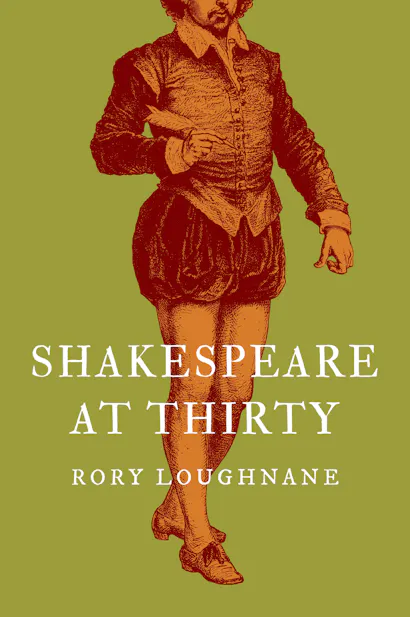
Shakespeare at Thirty provides an original account of Shakespeare's early career by going back to a moment before he became famous: the spring of 1594, when he turned thirty amidst plague lockdowns, censorship, social unrest, financial insecurity, and professional uncertainty.
Rather than reading Shakespeare's beginnings through the lens of his later achievements, Rory Loughnane reconstructs the precarious world in which a young actor and writer learned his craft and worked his way through a rapidly developing theatrical scene.Drawing on recent developments in textual studies, biography, and theater history, the book places Shakespeare's early plays and poems within the collaborative literary networks and volatile theater world of late Elizabethan London.This book examines the forms of co-authorship that formed the basis of many of Shakespeare's early works; The pressures imposed by censorship and authorities on theater workers; the economics of care; and emerging commercial structures that enabled a system of recurring theatrical performances. Above all, the book describes a talented but far from secure young writer whose career was influenced as much by his peers, circumstances, and other factors as by his innate genius.Providing a rare biographical and critical portrait of the playwright before he became a cultural icon, Shakespeare at Thirty brings the uncertainty back to Shakespeare's twenties, reveals how he had to grapple with the questions of direction, opportunity, and ambition that face all young artists, and challenges the narratives of determinism that dominate many Shakespeare biographies.
This result sheds new light on his early career, reminding us that Shakespeare too had to become himself.