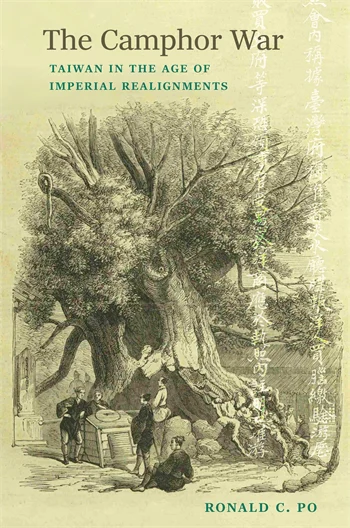
The First Opium War is remembered as the most prominent conflict between Britain and China in the 19th century. In stark contrast, the Camphor War of 1868 was forgotten.
The clash lasted only a few weeks, and arose out of Britain's desire to break the Qing dynasty's monopoly on the lucrative trade in camphor, which was grown in Taiwan and widely used for medicinal purposes. Although small in scale, the war has highlighted shifts in China's dynamics and Taiwan's engagement with the world.By examining this little-known conflict, Ronald C. Po how the Qing and British empires evolved during a period of reshaping empires and reorganizing borders.
The Qing dynasty adopted a more active approach to controlling its borders, regulating trade, and countering foreign aggression. By placing the war in the context of the first decades of the self-strengthening movement, Poe shows how the Qing state reshaped Taiwan from a border region into a political arena for negotiation, and how camphor became a commodity of commercial importanceAn extreme and means of struggle for power.
By focusing on this seemingly marginal war, the book shifts the focus from major confrontations to the precise mechanisms by which empires adapted, faltered, and reorganized. Combining maritime history, commodity history, environmental history, and imperial history, The Camphor War complicates rigid notions of empire and reveals Taiwan's importance in nineteenth-century East Asia.