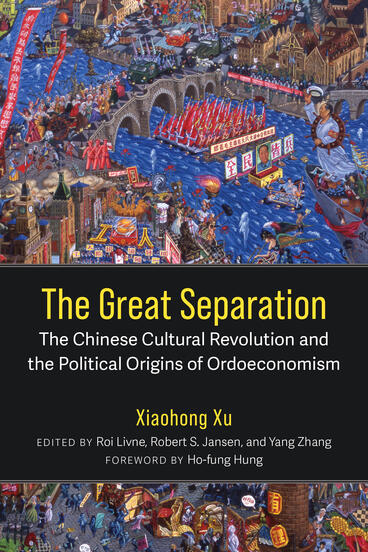
The Big Chapter offers insight into how culture and elite struggle influence politics, upending deterministic notions of China's Cultural Revolution and the market reforms that followed. This ambitious book, published posthumously by sociologist Xiaohong Xu, revisits previous scholarship on “neoliberalism” in China, showing that the quest to separate mass politics from economic policy predates the era of reform and opening-up.Over the course of the Cultural Revolution, unfolding factional dynamics and interpretive struggles enabled Chairman Mao and his fellow radicals to mobilize workers to advance their own political goals while neutralizing the economic demands of the masses, symbolically separating the political from the economic.This paved the way for a more comprehensive depoliticization of the economy after 1989, when China faced challenges from students and workers whose economic grievances quickly transformed into political demands for democracy. The result was what Shaw calls “ordinary economicism”: an ideology that prizes economic development, rejects mass politics, and views the state as the apolitical guardian of the economy.As Xu explains, although systemic economics may share some similarities with neoliberalism, it is a distinctly Chinese approach that must be understood on its own terms.
The Great Separation The Chinese Cultural Revolution and the Political Origins of Ordoeconomism
الانفصال الكبير: الثورة الثقافية الصينية والأصول السياسية للاقتصاد النظامي
Not Translated
Listen to book
Bibliographic Data
| Author | |
|---|---|
| Primary Category | Ideas and Policies |
| Published | 2026 |
| Language | English (EN) |
| Pages | 160 pages |
| Edition | الأولى |
| Dimensions | 6×9 |
| ISBN | 9780472078349 |
| Translation | Not Translated |
About Roi Livne
Roy Livney is an associate professor of sociology at the University of Michigan.
About Robert S. Jansen
Robert S. Janssen is an associate professor of sociology at the University of Michigan.
About Yang Zhang
Yang Zhang is an associate professor in the Department of Global Studies at American University.