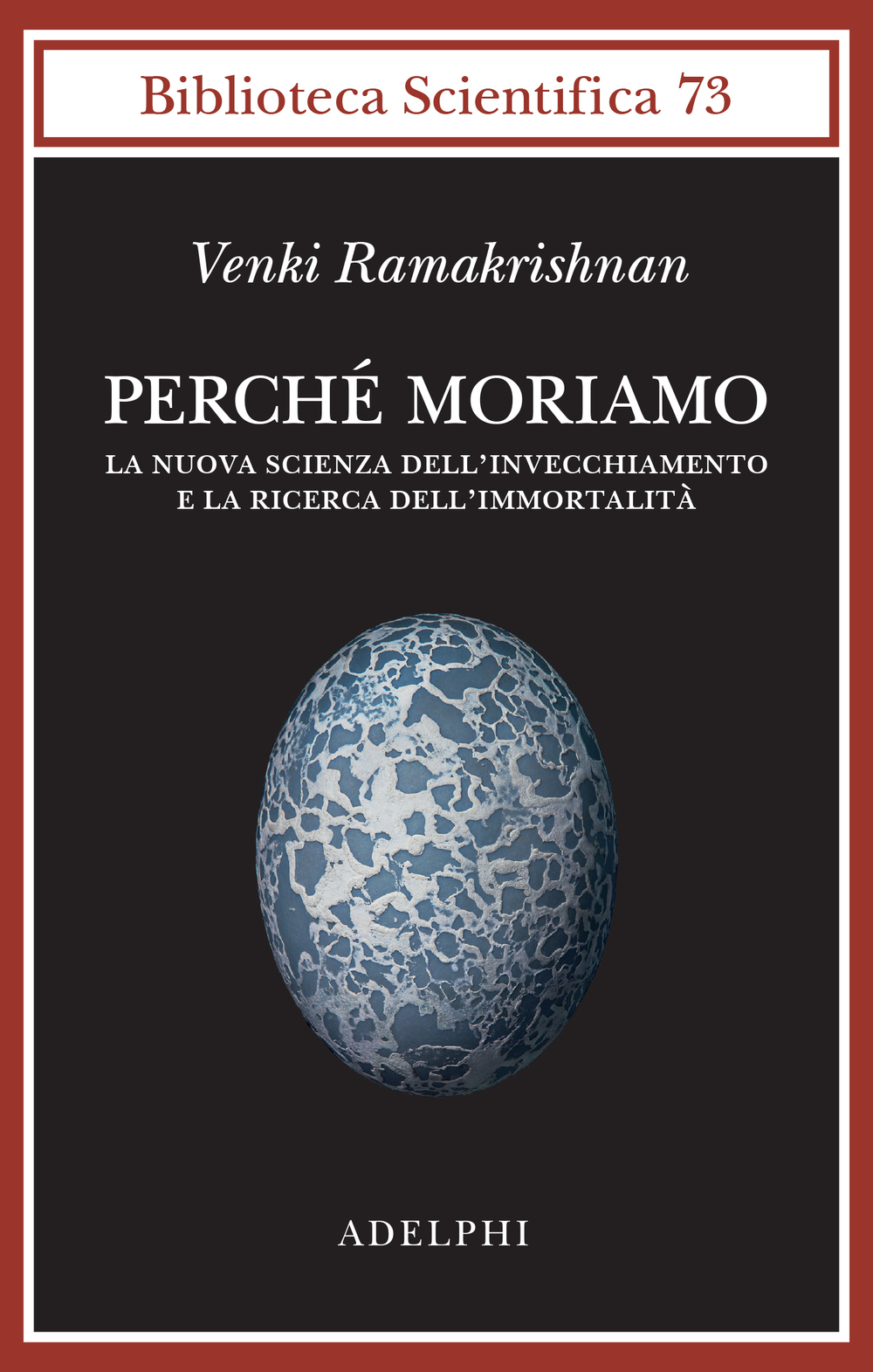
An exceptional scientific and philosophical book has recently been published by the prestigious Italian publishing house Adelphi entitled "Why Do We Die? The New Science of Aging and the Search for Immortality" (Perché moriamo. La nuova scienza dell’invecchiamento e la ricerca dell’immortalità). The book, which came in an Italian edition translated by Maurizio Bruno, was penned by the eminent molecular biologist Venki Ramakrishnan, winner of the 2009 Nobel Prize in Chemistry.The current biological revolution that attempts to decode the human pyramid, discussing the boundaries between scientific truth and the obsession with alleged digital and medical immortality.
Ramakrishnan begins his thesis by answering the obvious and terrifying question at the same time: What is aging? The author explains in a precise and rigorous scientific tone that aging is not just the passage of time, but rather a “continuous accumulation of chemical damage to molecules and proteins within our cells,” which ultimately leads to tissue erosion and failure of vital systems.Integrated in maintaining the cohesion of the human organism.
The book reveals an amazing truth: A person begins to age while he is still in his mother’s womb, but in its early stages the body possesses a sophisticated arsenal of DNA self-repair mechanisms. But as the decades pass, and the hypothetical biological ceiling for human lifespan is reached (which is estimated at 120 years), the pace of damage begins to exceed the ability of cells to repair themselves, and the biological machine begins to collapse in an orderly manner.## The “Illusion of Immortality” Trading and the Paradoxes of Biotechnology
Ramakrishnan deconstructs the contemporary obsession with longevity, which in the last decade has turned into a multi-billion-dollar industry; More than 300,000 scientific articles appeared and about 700 startup companies were founded seeking to circumvent death. The researcher firmly criticizes the shallow studies and false promises promoted by Silicon Valley companies, noting that techniques such as “excessive price restriction” or “using stem cells to reprogram organs” may help...Improving the quality of life, but completely unable to produce true immortality, given the impossibility of completely replacing or reprogramming the human brain.
The author warns that “trying to prolong life indefinitely is like chasing a technological mirage”; Excessive lifespan extending for hundreds of years will lead humanity to a frightening social stagnation, and will create stagnant societies that reproduce the same elites and ideas without renewal.