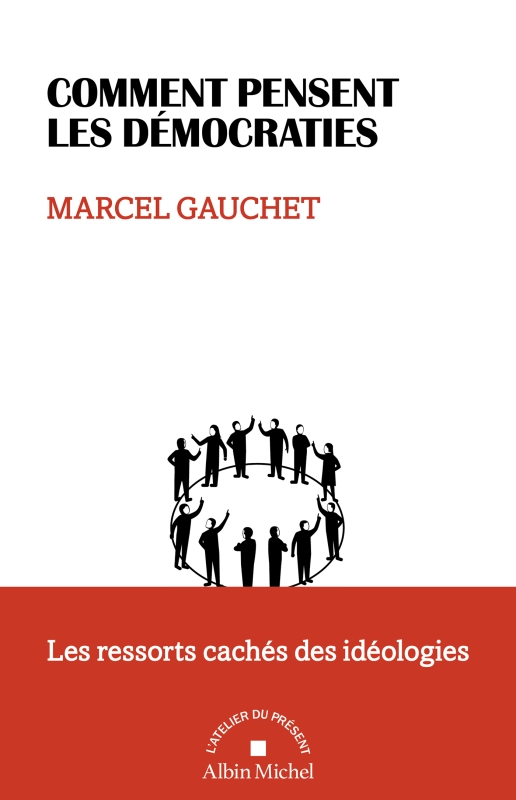
The prominent French philosopher and historian, Marcel Gauchet, in his book published in the beginning of the year two thousand and twenty-six, entitled How Democracies Think, discusses the hidden mechanisms of ideologies, the deep structure of modern political thought, and how ideological identities are formed within pluralistic systems.This huge intellectual work, published by Albin Michel, contains approximately two hundred and seventy-two pages, to provide a renewed philosophical and historical reading that deconstructs the common concept of ideology as merely a tool for conflict or deception. Rather, the writer sees it as a structural component that cannot be separated from the democratic experience itself from its birth in the nineteenth century until the present moment dominated by neoliberalism.In his thesis, Gaucher starts from a historical review of the term coined by the philosopher Antoine Destut de Tracy at the end of the eighteenth century, trying to investigate the radical change that occurred in human societies when they moved from a pattern of religious obedience and compliance with the past to a pattern of inventing the future and elevating human will. The author believes that with the decline of traditional religious authority as a frame of reference that explains the world and organizes social relations, it has left behind a huge cognitive and existential vacuum, which has pushed societies...The emerging democracy led to the search for intellectual alternatives capable of filling this void and directing the new human freedom towards specific goals, and from here modern ideologies were born to play the role of alternative interpretive networks that give individuals and groups an integrated vision about their societies and their common future.The book presents a clear epistemological break with the classic Marxist thesis that dominated the intellectual arena for many decades, which reduced ideology to being merely an intellectual and justification tool to serve the interests of the ruling bourgeois class and establish its capitalist hegemony. In contrast to this narrow economic interpretation, Marcel Gauchet proposes a deeper interpretation that goes beyond pure capitalist dynamics to focus on the existence of a political and cultural dynamic specific to modern societies that live in and create history where they are born.The political and social transformations in every era are what the writer calls the thinkable and believable spaces, which are the deep intellectual reservoirs from which various ideologies derive their primary materials and political slogans to form collective consciousness and direct the compass of public opinion.Through the chapters of the book, Gaucher reviews the historical succession of the major ideologies that have dominated the European and Western mind since the nineteenth century, tracing the rise and fall of the liberal, nationalist, and socialist currents and how each of them was able at its time to provide comprehensive answers to the troubling questions posed by industrial and political progress. The analysis focuses in particular on the fundamental behavioral shift that has occurred since the 1970s with the resounding rise of neoliberalism, which did not merely change policies.Rather, it caused a silent and profound revolution in the political and social features of democratic societies by dismantling traditional group bonds and transforming society into atoms of separate individuals, which led to the emergence of an unprecedented crisis in the structure of democracy itself.The French philosopher draws attention to the stark paradox experienced by the contemporary world, which is that despite the apparent defeat of major totalitarian ideologies such as communism and fascism and the supremacy of belief in the end of the ideological age, the current liberal democracies are sinking into a new type of intellectual and doctrinal sclerosis. This crisis is manifested in the emergence of absolute individualism, rising populism, and a decline in confidence in representative institutions, as democracy has transformed from a collective project to build the future into a mere mechanism.Legal law to protect individual rights, which threatens to empty the political system of its moral and social content and renders democracies unable to think of themselves as a unified whole and manage their affairs in solidarity.
Comment pensent les démocraties: Les ressorts cachés des idéologies
كيف تفكر الديمقراطيات: المصادر الخفية للأيديولوجيات
Not Translated
Listen to book
Bibliographic Data
| Author | |
|---|---|
| Publisher | Albin MichelWebsite |
| Publisher Address | info-site@albin-michel.fr |
| Country | France |
| Primary Category | Ideas and Policies |
| Published | 2026 |
| Language | French (FR) |
| Pages | 272 pages |
| Edition | First edition |
| Dimensions | 14×22 |
| ISBN | 9782226507976 |
| Translation | Not Translated |
Articles About This Book
Essence of Ideas
كيف تفكر الديمقراطيات: الدوافع الخفية للأيديولوجيات
Comment pensent les démocraties: Les ressorts cachés des idéologiesMay 9, 20267 min