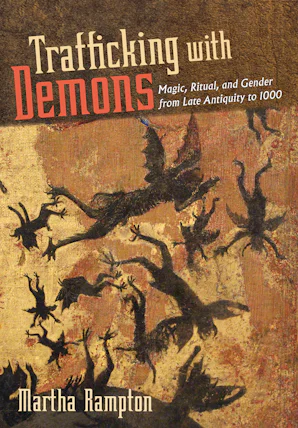
Demon Trafficking explores how witchcraft was viewed, practiced, and banned in Western Europe during the first millennium AD.
Through the intersecting frameworks of religion, ritual, and gender, Martha Rampton links the early Christian view of pagan magic with later doctrines and doctrines. By challenging prevailing views about the role of women in ritual magic during this period, Rampton offers a new account of the ways in which magic was integrated into the basic assumptions of Western European society, influencingPeople's understanding of the universe, divinity, and their Christian faith.
As Rampton shows, during the first Christian millennium, magic was thought to play a natural role in the workings of the universe, and to exist within a rational universe hierarchically arranged according to a “great chain of being.” Dealing with the "demons of the underworld" was the essence of magic. Interactions with these demons occurred in highly formal ritual contexts, but also routinely and transiently.Rampton traces the rivalry between pagan magic and Christian belief from the first century AD, when it reached its peak, through the early Middle Ages, as primitive forms of magic mutated and found refuge in the daily customs of professing peoples, and new paganisms entered Europe with their own magical forms. By the year 1000, she concluded, many forms of magic had been tamed and, in the estimation of the elite, essentially ineffective, as were the women who practiced them and the rituals that accompanied them.