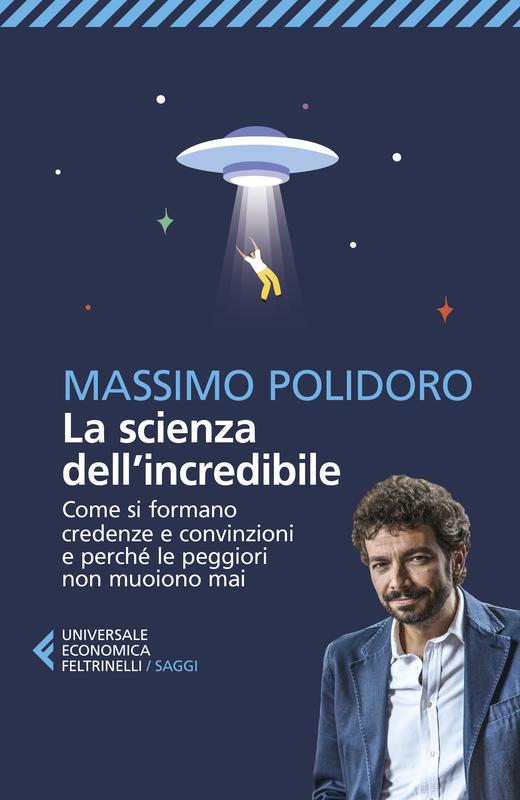
“The Science of the Unreasonable”: A new book by Massimo Polidoro deconstructs the psychobiology of false beliefs and reveals the mechanisms of reality distortion in the age of social media
Scientific and cultural circles witnessed the publication of a very important epistemological survey book titled “La scienza dell'incredibile: Come si formano credenze e convinzioni e perché le peggiori non mu and no mai” (The Science of the Unreasonable: How Beliefs and Convictions Are Formed and Why the Worst of Them Never Die) by the prestigious Italian publishing house “Giangiacomo.”Feltrinelli." This book is part of the "Global Economic Rights Books" series, in two hundred and fifty-six medium-sized pages. It presents an accurate scientific and psychological dissection of how the human mind formulates its belief system, revealing the secrets behind millions of people's adherence to the most strange or absurd ideas, and their transformation of mere illusions and passing suggestions into solid, unquestionable truths, which makes it a necessary knowledge document for understanding contemporary human behavior and decoding popular intellectual counterfeiting.This work derives its great intellectual credibility from the distinguished academic and professional identity of its author, Massimo Polidoro, a writer, researcher, and professor of scientific communication at Italian universities. Polidoro is known as the co-founder, along with the famous theologian of scientific minimalism Piero Angela, of the Italian Committee for the Verification of Pseudoscience Claims (CICAP). Polidoro has a long career in pursuing illusions and myths and dismantling the structure of irrational thinking. In this book, he steps awayThe author breaks from the traditional academic preaching style, to take the reader on a journey through incredible realistic stories, with the aim of exploring the deep biological and psychological roots that drive the human being to constantly search for “making meaning” and interpreting everything that surrounds him, even if this leads him to adopt the most devoid of explicit ideas.The structure of the analysis in the book is based on a basic psychological fact, which is that personal beliefs and convictions have a tremendous ability to distort and change the way we perceive and view the world around us. Polidoro explains that this distorted mental system clearly appears among those who see conspiracies around every corner, and who seek false reassurance in the arms of psychics, charlatans, and fake healers of various origins and backgrounds, all the way to radical groups that commit atrocities and crimes.Under the pretext of defending sacred beliefs. The author devotes important space to analyzing the dangerous and destructive role that social media platforms and Internet networks play in directing and multiplying these beliefs, by falsifying the awareness of the masses, exploiting ready-made cognitive biases, and entrenching intellectual division.The book explains with much scientific evidence that understanding the embryonic origins of our convictions represents the basic gateway to understanding ourselves and understanding objective truth better. Hence, Polidoro offers the reader a practical guide to learning about the tools of rigorous scientific investigation and investigation, and how to test the reliability and validity of common ideas. This intellectual exercise, according to the author, contributes to making the individual aware of his cognitive limitations and innate mental errors, and makes him ready and courageous to change his opinions and convictions if he encounters evidence.Scientific and conclusive evidence that contradicts what he believes in, in addition to giving him the skill of dealing properly and calmly with people who refuse to listen to the language of reason and logic.
The book “The Science of the Unreasonable” received high critical praise from leading scholars and thinkers in Italy. The prominent Italian biologist and philosopher Telmo Pifani wrote a foreword to the book, describing it as “a valuable and rare book that trains us to say ‘no’ to quick mental shortcuts and psychological tricks.” At the end of his thesis, Polidoro concludes that the only antidoteWhat is effective in protecting societies from the epidemic of bias, intolerance, and prevailing myths does not lie in forcibly imposing knowledge, but rather in cultivating and nurturing one inexhaustible human quality: “endless cognitive curiosity.”