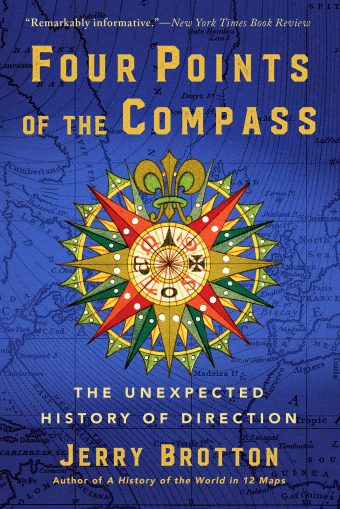
From the New York Times bestselling author of A History of the World in 12 Maps, this is the revelatory history of the four cardinal directions that have oriented and defined our place on the globe for millennia
North, south, east, and west: almost all societies use these four cardinal directions to orientate themselves and to understand who they are by projecting where they are. For millennia, these four directions have been foundational to our travel, navigation, and exploration, and are central to the imaginative, moral, and political geography of virtually every culture in the world. Yet they are far more subjective—and sometimes contradictory—than we might realize.
Four Points of the Compass leads us on a journey of directional discovery. Societies have understood and defined directions in very different ways based on their locations in time and space. Historian Jerry Brotton reveals why Hebrew culture privileges east; why Renaissance Europeans began drawing north at the top of their maps; why early Islam revered the south; why the Aztecs used five color-coded cardinal directions; and why no societies, primitive or modern, have ever orientated themselves westwards. In doing so, politically-loaded but widely used terms such as the “Middle East,” the “Global South,” the “West Indies,” the “Orient,” and even the “western world” take on new meanings. Who decided on these terms and what do they mean for geopolitics? How have directions like “east” and “west” taken on the status of cultural identities—or more accurately stereotypes?