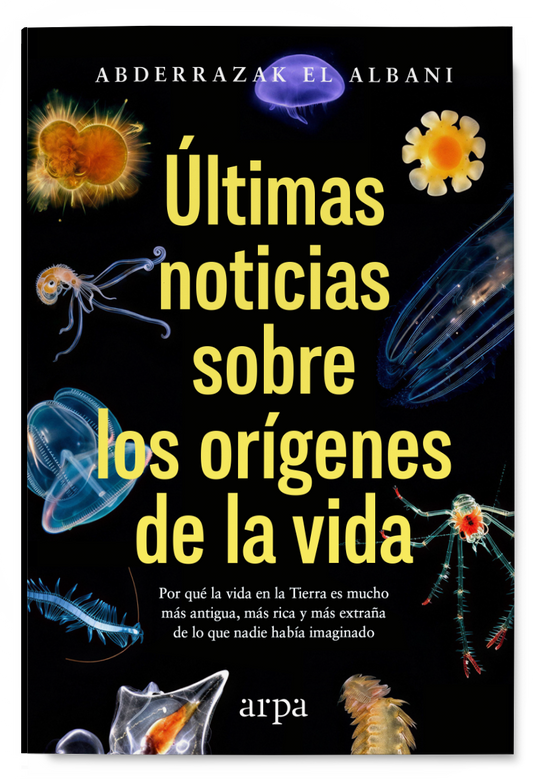
How did the Earth transform from being a boiling ball of magma to a land inhabited by living organisms?
In 2008, Abdel Razzaq Al-Albani was studying sediments in Gabon when he inadvertently discovered hundreds of fossils that science had deemed impossible to exist. These fossils were multicellular organisms 2.1 billion years old, 1.5 billion years earlier than the theory inherited from Darwin set as the date for the emergence of complex life.The cover of Nature celebrated this discovery, and with it the certainty that the history of life on Earth is much older and richer than anyone had imagined. This book tells the story of everything science has achieved since that day.
From the perspective of the game-changing scientist, Al-Albani explores the great mysteries left open by the discovery: how the first cell was born, what role oxygen and the environment played in the explosion of complex life, what meteorites reveal about our origins, and how far research goes today.With the clarity of a great teacher and the honesty of someone who has seen his own certainties shaken, Al-Albani shows us that science advances precisely because it knows how to recognize what it ignores.