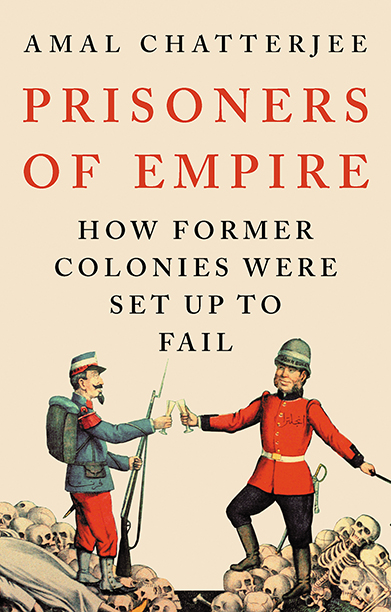
A compelling social and political balance of empire, revealing how former colonies around the world remain bound by the legacy of colonial oppression.
Why do some former colonies fail, floundering from one crisis to another, while others recover? Why did many of them succumb to dictatorship, corruption, civil war, and instability after independence?Amal Chatterjee argues that these “failures” are based on entrenched and durable colonial structures that maintain and reproduce the oppressive and exploitative systems of the past. From land ownership to mining, from transportation networks to educational provision, from ethics to law, many postcolonial institutions function in much the same way as they did under foreign rule, where power remains concentrated in the hands of elites, and inequalities are deeply rooted.Drawing on a wide range of contemporary and historical materials, including memoirs, economic data, and administrative documents, Chatterjee explains how the empire not only made its colonies places of extraction and exploitation, but keeps them so today.It presents a truly global narrative – from the British to the Belgian Empire, from Mexico to Mozambique, from the Sahel to Sri Lanka – showing how extractive capitalism and colonialism are intertwined, and how human rights and development are hostage to the demands of profit.
It is still possible to challenge and change the world built by empires – but to design a new future that is fair for all, we must first understand the legacy of the past.