
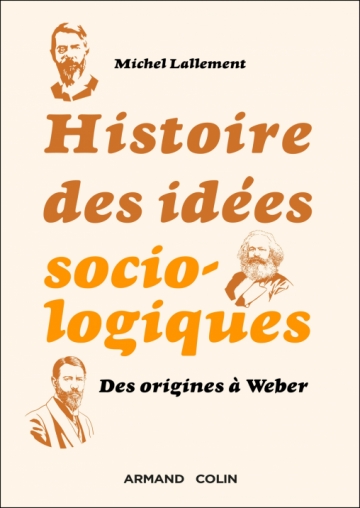
In the sixth updated edition of his huge reference book entitled The History of Sociological Ideas from the Greek Cradle to Global Sociology, published by the prestigious Arman Collin publishing house, Michel Lallmont, the prominent French sociologist and academic, takes us on an enjoyable intellectual and historical journey that deconstructs the deep structure of human social thinking and traces the stages of its development throughout the ages. This comprehensive encyclopedic work comes to represent an indispensable basic foundation for every researcher and student who seeks to understand how human consciousness is formed.about social phenomena and how this contemplation has transformed from mere general philosophical ideas into an independent science in its own right that has its own rigorous methods and advanced research tools capable of monitoring the transformations of contemporary societies and interpreting their increasing complexities in light of globalization that has swept away many traditional cultural and social peculiarities in its path.In his thesis, Lallamont begins with a very deep and broad historical review, as he rejects the common reductionism that dates sociology to its modern appearance in the nineteenth century. Rather, he takes the reader back to the first roots, or what he calls the Greek cradle, tracing the fundamental questions raised by Greek philosophers such as Plato and Aristotle about the nature of the state, justice, and human society, and how those early ideas established the philosophical frameworks from which subsequent theories derived their primary materials. The writer brilliantly reviewsThe major intellectual transitions through the Middle Ages and the Renaissance, leading to the Age of Enlightenment and the Industrial Revolution. These are the stages that witnessed a profound disruption in the social and political structures of Europe, which imposed an urgent need for the birth of a new science that would undertake to understand these modernizing transformations and formulate laws that explain the movement of society and ensure its stability in the face of stormy crises.The book devotes extensive space to analyzing the works of the founding fathers of modern sociology, going beyond the dry biographical narrative to a deconstructive dive into the cognitive contents of the theses of major thinkers such as Auguste Comte, Karl Marx, Emile Durkheim, and Max Weber. Lallmont explains how these intellectual figures contributed to building the methodological bases of science by formulating the concepts of social solidarity, class conflict, social action, and rationality, concepts that still constitute the diagnostic backbone of the social sciences to this day.To this day, the author's analysis is distinguished by the ability to highlight the hidden links and methodological intersections between these disparate schools of thought and how the ongoing critical dialogue between them constituted a strong impetus for the development of sociology and the diversity of its tools between quantitative and statistical analysis and between qualitative and interpretive interpretation.The exceptional importance of this updated sixth edition lies in its comprehensive keeping pace with the radical transformations that have occurred on the scene of sociology in the twenty-first century, where science is no longer confined to the Western-centric theories that dominated for many decades, but rather has opened up strongly towards what the author calls global sociology. The writer reviews with sharp intelligence the rise of global sociology and post-colonial studies, which has restored consideration of intellectual theses coming from outside the European and American space, such asContributions of sociologists in Asia, Africa, and Latin America. The book discusses how the phenomena of globalization, cross-border digital networks, and contemporary climate changes have forced sociologists to reconsider their traditional concepts about the national state and local society and formulate new paradigms that suit this interconnected and turbulent world.The book The History of Sociological Ideas represents a high-level cognitive and pedagogical document characterized by a sober and clear academic language at the same time, which makes it available to specialists and general readers interested in understanding the mechanisms of the functioning of societies. Michel Lallmont confirms through this encyclopedic work that the strength of sociology does not lie in providing definitive answers or ready-made recipes for social problems, but rather in its continuous ability to ask troubling critical questions, dismantle axioms, and urge people to think about the conditions of their collective existence.This wonderful combination of depth of analysis and breadth of historical horizons makes the book an inspiring classic reference that contributes effectively to preserving humanity’s intellectual memory and opens new windows for building a more aware, just, and solidarity-based social future.
The history of sociological ideas from the Greek cradle to global sociology
تاريخ الأفكار السوسيولوجية من المهد اليوناني إلى علم الاجتماع العالمي
Not Translated
Listen to book
Bibliographic Data
| Author | |
|---|---|
| Publisher | Armand ColinWebsite |
| Country | France |
| Primary Category | Social Studies |
| Published | 2026 |
| Language | French (FR) |
| Pages | 544 pages |
| Edition | The first |
| Dimensions | 17×24 |
| ISBN | 9782200643256 |
| Translation | Not Translated |
About Michel Lallement
Michel Lallement is Professor at Cnam (Chair of the Social Analysis of Work, Employment and Organizations) and member of Lise-CNRS. He wrote especially about compelling tensions. Max Weber, Economy and Sensationalism (Gallimard, 2013), The Logic of Class. Edmond Goblot, The Bourgeoisie and Social Discrimination (Les Belles Lettres, 2016) and Jeunesse de la socialologie du travail française (1946-1955) (Droz, 2026).