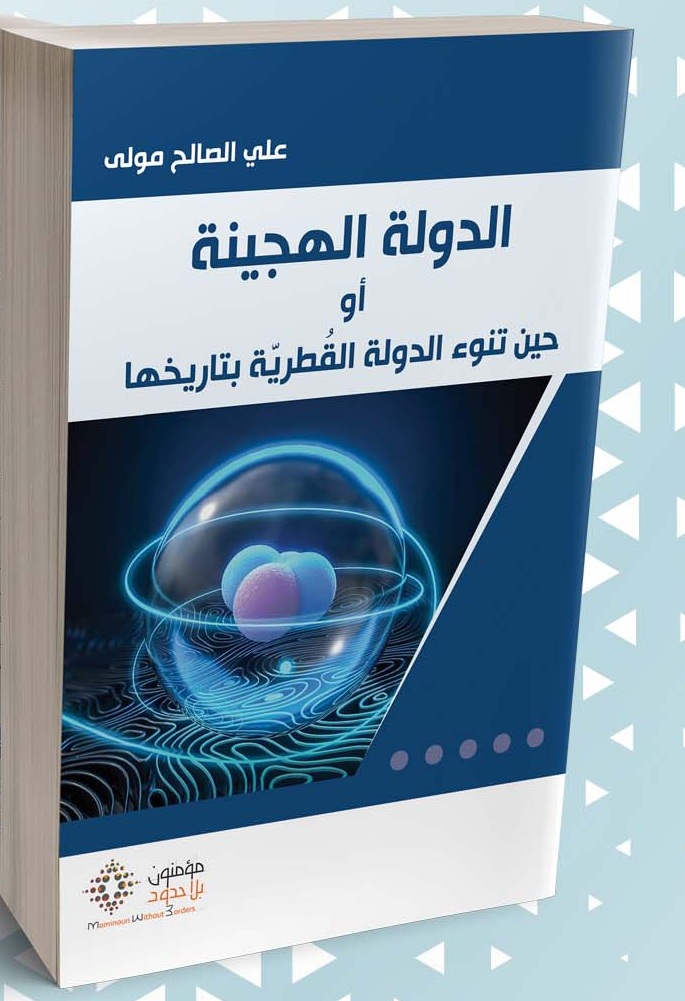
We started from the hypothesis that the impasses that disrupted the contemporary Arab state’s inclusion in modern times in terms of the networks of values that control it were primarily due to its being a hybrid state. If this is so, its problems are part of its existence, and not historical mistakes that can be justified and overcome. Therefore, we distinguished the error arising from experience from the configurational problem.Researching the problem requires explanation, not justification. The interpretation required that our approach be analytical and deconstructive to suit the consideration of the structure of the state. We benefited from diverse knowledge that we brought from many fields as we researched the contexts of the birth of the national state, the sites of hybridization at the level of the state, leadership, discourse, and identity, and its consequences and the possibilities of mitigating its harms.If we propose the term “hybrid state,” it is because it responds precisely to the requirements of the vision that governs all aspects of this book. We chose it because it gives the state an identity feature. In this, it shares with all the definitional formulations included in the adjective compounds such as the failed state, the rogue state, and the tyrannical state.And the stuck state, and the impossible state, and the torn state... However, it differs from it qualitatively in at least one respect, and it is what gives it what it specializes in. If the definitional adjectives that we mentioned define the state with its biography and fate based on what is deduced after observing its performance, then defining the state with the adjective “hybridity” is a definition of formation, not of experience. Here, the approach intervenes with the contexts on which we rely, as they are located in what is before, not in what is after.
The hybrid state is when the national state struggles with its history
الدولة الهجينة أوحين تنوء الدولة القُطريّة بتاريخها
Not Translated
Listen to book
Bibliographic Data
| Author | |
|---|---|
| Publisher | Believers Without Borders Foundation for Studies and ResearchWebsite |
| Country | المغرب |
| Primary Category | Social Studies |
| Also In | |
| Published | 2026 |
| Language | Arabic (AR) |
| Pages | 430 pages |
| Edition | The first |
| Dimensions | 6.3 x 1.4 x 9.3 inches |
| ISBN | 2582410085640 |
| Translation | Not Translated |
About Ali Al-Saleh, Mawla
Lecturer at the Faculty of Arts and Human Sciences, Sfax - Tunisia.